What I think
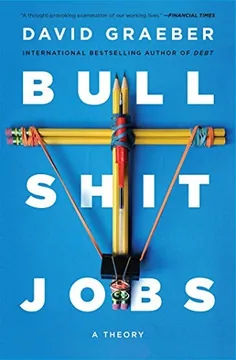
In 2018, when I read Bullshit Jobs, I felt very validated. I was still hurting from some really bad experiences toward the end of my full-time journey, and I was very much in a “work sucks, we must reject work” mode. The book made me reflect on my many bullshit jobs over the years and realize I might have had an entire bullshit career.
Now I just have a broader definition of work and a much healthier relationship with it. I still think the book is funny, and I think it makes a good point.
Many people argue that Bullshit Jobs doesn’t make sense because, at an abstract level, if jobs weren’t efficient, they would be eliminated. I think this is wrong, for two reasons.
First, jobs aren’t that efficient. A lot of jobs actually get automated in recessions. Economists Nir Jaimovich and Henry Siu found that about 90 percent of the decline in routine jobs happened in the last three recessions. Brad Hershbein and Lisa Kahn found that the Great Recession accelerated the shift toward technology and more skilled workers. There’s also a well-documented reluctance to let people go, which economists call labor hoarding.
Second, I think we should just trust people when they tell us what they think of their own work. Many people do work in jobs they personally feel are pointless. This is a massive deficit of human capacity and aliveness that we should take seriously. I talk to people all the time who feel this, and the amount of shame and guilt they feel for simply wanting to find an alternative is wild.
What the book is about
Graeber defines a bullshit job as one the person doing it can’t justify, even though they have to pretend otherwise. He separates these from shit jobs, which are useful but badly paid and badly treated. He sorts bullshit jobs into five types, traces how we came to treat time as something that can be bought, and asks what all this pointless work is doing to the people stuck in it.
Highlights
The core thesis
I would like this book to be an arrow aimed at the heart of our civilization. There is something very wrong with what we have made ourselves. We have become a civilization based on work—not even “productive work” but work as an end and meaning in itself. We have come to believe that men and women who do not work harder than they wish at jobs they do not particularly enjoy are bad people unworthy of love, care, or assistance from their communities.
A bullshit job is a form of paid employment that is so completely pointless, unnecessary, or pernicious that even the employee cannot justify its existence even though, as part of the conditions of employment, the employee feels obliged to pretend that this is not the case
If the preponderance of those engaged in a certain occupation privately believe their work is of no social value, one should proceed along the assumption that they are right
Shit jobs and bullshit jobs
Shit jobs tend to be blue collar and pay by the hour, whereas bullshit jobs tend to be white collar and salaried. Those who work shit jobs tend to be the object of indignities; they not only work hard but also are held in low esteem for that very reason. But at least they know they’re doing something useful. Those who work bullshit jobs are often surrounded by honor and prestige; they are respected as professionals, well paid, and treated as high achievers—as the sort of people who can be justly proud of what they do. Yet secretly they are aware that they have achieved nothing
It’s as if businesses were endlessly trimming the fat on the shop floor and using the resulting savings to acquire even more unnecessary workers in the offices upstairs.
The five types
Flunky jobs are those that exist only or primarily to make someone else look or feel important
in most cases, goons are clearly doing something to further the interests of those who employ them, even if the overall effect of their profession’s existence might be considered detrimental to humanity as a whole.
employees whose jobs exist only because of a glitch or fault in the organization; who are there to solve a problem that ought not to exist.
employees who exist only or primarily to allow an organization to be able to claim it is doing something that, in fact, it is not doing.
This job can be considered bullshit if the taskmaster herself believes that there is no need for her intervention, and that if she were not there, underlings would be perfectly capable of carrying on by themselves
The performance of usefulness
Once you introduce formal measures of success, “reality”—for the organization—becomes that which exists on paper, and the human reality that lies behind it is a secondary consideration at best
the immediate material manifestation of that manager’s power and prestige is the visual quality of his presentations and reports. The meetings in which such emblems are displayed might be considered the high rituals of the corporate world
Learning to pretend
From Graeber’s list of what student jobs teach young people:
how to pretend to work even when nothing needs to be done;
Young people in Europe and North America in particular, but increasingly throughout the world, are being psychologically prepared for useless jobs, trained in how to pretend to work, and then by various means shepherded into jobs that almost nobody really believes serve any meaningful purpose.
Spiritual violence
The most common complaint among those trapped in offices doing nothing all day is just how difficult it is to repurpose the time for anything worthwhile.
Time
the idea that one person’s time can belong to someone else is actually quite peculiar
By the fourteenth century, most European towns had created clock towers—usually funded and encouraged by the local merchant guild. It was these same merchants who developed the habit of placing human skulls on their desks as memento mori, to remind themselves that they should make good use of their time because each chime of the clock brought them one hour closer to death
Caring work and pay
It’s commonplace to hear that grade school or middle school teachers shouldn’t be paid well, or certainly not as well as lawyers or executives, because one wouldn’t want people motivated primarily by greed to be teaching children. The argument would make a certain amount of sense if it were applied consistently—but it never is. (I have yet to hear anyone make the same argument about doctors.)
In 2020, I wrote that I wouldn’t be surprised to see more exceptions emerge as more attention gets paid to the importance of many of these “essential” jobs. For one thing, I expect more doctors to be heads of hospitals instead of business majors.
I wanted to do something useful with my life; work that had a positive effect on other people or, at the very least, wasn’t hurting anyone. But the way this economy works, if you spend your working life caring for others, you’ll end up so underpaid and so deeply in debt you won’t be able to care for your own family.
The question that matters
Even a modest Basic Income program could become a stepping-stone toward the most profound transformation of all: to unlatch work from livelihood entirely
how should society be best arranged to produce the sort of human beings one would like to have around, as friends, lovers, neighbors, relatives, or fellow citizens? This is the kind of question that concerned Aristotle, Confucius, and Ibn Khaldun, and in the final analysis it’s still the only really important one.
The 2018 book club discussion
I ran a virtual book club discussion on Bullshit Jobs in 2018. The discussion guide focused on ten key issues from the book:
- Bullshit jobs definition: have you ever had a bullshit job?
- Five types of BS jobs
- “Shit” jobs and the equal pay argument
- From fried locusts to the “time famine”
- Three types of unpaid labor
- Public sector vs. private sector
- Service economy? Or not?
- Politics: obsessed with jobs?
- Brief history of labor and economics
- The answer: Oprah gives everyone UBI?
Bullshit Jobs by David Graeber - Virtual Book Club Discussion from Boundless
You can also see the presentation on Speaker Deck.