
What I think
I am the 100% target market for this book. If you are nerdy, like stumbling upon interesting references, and think a lot about the nature of work as an indie professional, then you should buy this book.
It’s the best book I’ve read on consulting by far. Perhaps the only one that really captures the advanced “inner game” of indie and gig life generally. If you are at all thinking about freelancing or are an independent consultant, it’s the only indie book worth paying attention to.
Generally, I vibe with Venkat’s style because I prefer improv style more than polished corporate or big consulting style work. One thing he does well is put indie consulting in the context of business thinking and the history of big consulting. I joked that he has a better understanding of all this than most big company consultants.
It’s also probably a great use of time if you’re a full-time worker and want to test how it might feel to be indie.
If you don’t like 2x2s, you should probably avoid the book. There are lots of them, and they really help you think through different trade-offs.
What the book is about
Rao, an independent consultant and writer, treats indie consulting as a craft. The books cover the practical side of gig work, including pricing, clients, deliverables, and positioning. They also cover the inner game: identity, money, social life, and how to build a life once a paycheck no longer supplies the structure. Part 1 opens with 42 maxims for indie consultants.
Highlights
The 42 maxims
At the beginning of the book, he offers 42 maxims, and he prompts you to just note if you react strongly, positively, or negatively. I love this exercise because if you are going to be an indie consultant, you need to have strong stances and points of view on how you are going to do the work. This book will help you work through some of those and so maybe it’s good to check this at the beginning and after reading the book. Here are a few that stood out as an example.
Avoid polished deliverables.
my take
I love this one. In my experience, the takeaway is much more about speed and aligning with the energy of the engagement you’re working on. Pulling up a Google Doc with some half-baked thoughts for a client to react to on day two is often much more useful than a polished deliverable in week three.
Keep your public identity a 10-foot-pole away from your gigwork.
my take
I’ve pretty much embraced this since I became self-employed. A lot of my energy goes toward my strategy business, and I’ve always done gigs here and there, but I’ve never tried to turn my identity into “successful strategy consultant.” People find me if they find me. I do a certain kind of work for certain kinds of clients, but my public identity is much more about my own curiosity, and I don’t worry about it undermining my consulting.
Do not accept work when broke that you would reject when flush.
my take
I have a strong reaction to this one, mostly because I’ve made the mistake. I’ve taken a couple of client projects when I felt desperate and wasn’t confident about my runway or my ability to find work in the future. As soon as you take these kinds of projects, you know within the first week. Over time, I’ve improved my decision criteria so I go through a rigorous check to make sure I’m not taking them.
If a client asks for an ROI estimate, walk away.
my take
This is a good one, mostly because the request signals not having much experience with consulting, especially with indie consultants. As an indie consultant, your work is a lot more emergent and will evolve a lot. It’s closer to working with a really talented employee than to following a structured implementation plan, like working with Accenture on an ERP system.
Systematic doubt
I love the framing of systematic doubt vs. systematic confidence. I tend to play in Achiever mode with my training.
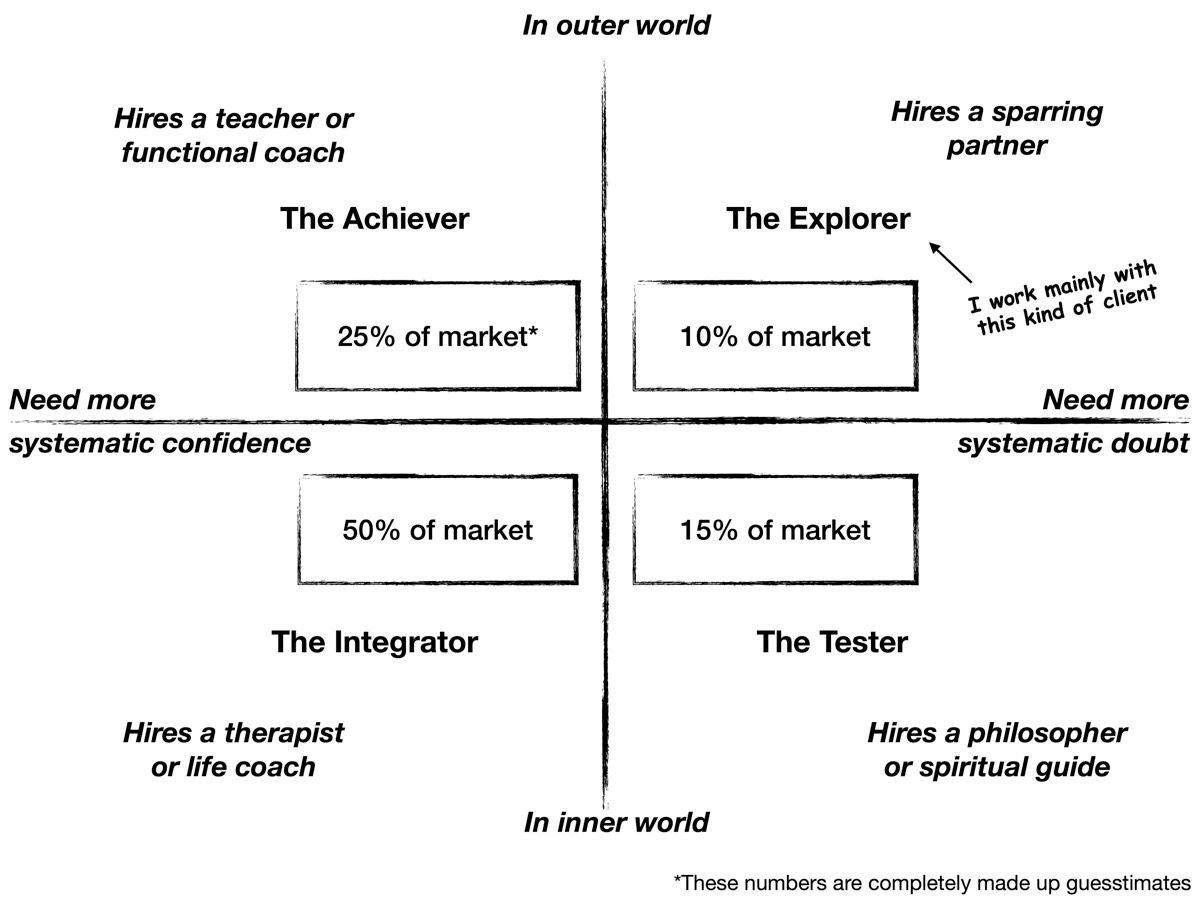
The four types of clients, from Art of Gig.
Passion work first
And you heard that right: you arrange the money-making around the passion work, not the other way around. You try to reserve your most alert and creative days and hours for the passion work
my take
This is something I’ve always done. I really enjoyed writing early on, and after spending 10 years doing work I kept trying to escape, I knew I wanted to protect it—not try to monetize it, scale it, or build my identity or business around it.
Writing, creative work, and broader pathless work have always been the passion work for me. I fund that by other means unless earning money from it is easy and in the flow of my life, as it has been with some of my books. But I’ve made the majority of my money from non-book, non-pathless stuff.
Sneaking off from an under-full to-do list doesn’t work, just as weight-training with no weights doesn’t work. You strengthen your sneak-off boldness by stealing from committed time, not by clearing and occupying free time
Big consulting
Rao says the Big-Three consulting world “selects for intelligent, high-energy grinders, not snowflake philosophers driven by foundational curiosities.” It took me a while to realize I was a snowflake philosopher. 🤣
I strongly agree that many large organizations “are so dysfunctional, they effectively have to be run by the big-firm consultants who service them,” and that “a good part of the consulting market is a corporate assisted-living facility for geriatric companies.”
His line that rank-and-file consultants are “more paychecky than ordinary paycheck types” and “the truest Organization Men” made me laugh because it’s true and I was one.
Indies could learn a lot from paying more attention to big consulting. As he puts it, their playbooks “offer a lot of good raw material for indie consultants.” I often remix their frameworks or use them as starting points.
A good strategy consultant is often simply someone who is good at just being present in a situation without becoming yet another part of the problem. This can be surprisingly hard to do.
The inner game
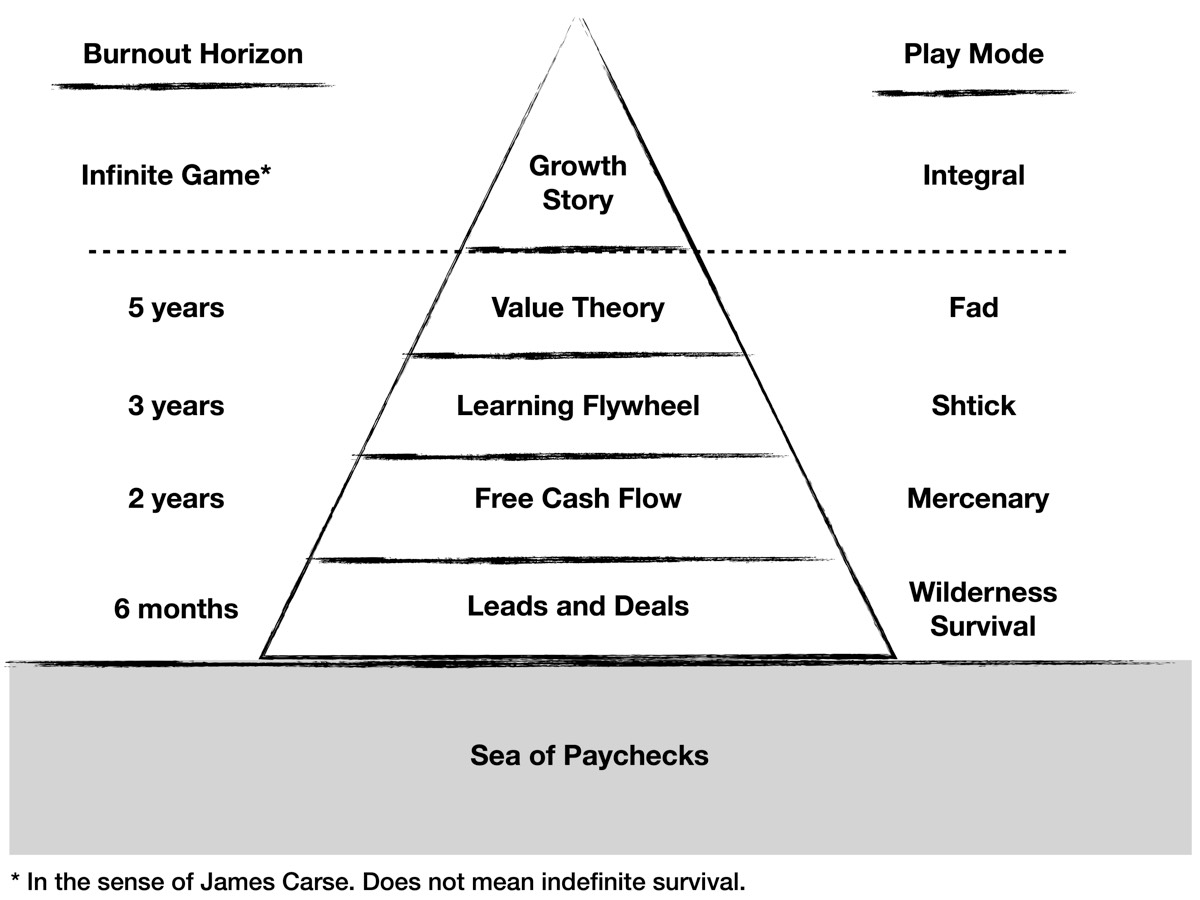
The gigwork hierarchy of needs, from Art of Gig.
I loved this. I love this map of the pyramid for a freelancer because at first you’re just trying to survive, and over time, you really are trying to arrive at a place that is sustainable over a long period of time.
Too many people focus on the money and earning a replacement income. As Rao correctly points out, “the inner game of gigwork is much simpler than the outer game, but much harder.”
He also suggests that “the best way to tackle it is to not even realize how hard it is before diving in, and then working it all out under live-fire conditions.” I was naive when I leaped, and this was probably good!
One of the biggest benefits of working independently is that “you will never have the luxury of blaming someone else for your choices.”
He argues that “constructing our identities primarily in terms of how we relate to the paycheck folkway is no longer good enough.” I notice this oppositional stance, and I think it’s a failure mode. We need to be more generative and imaginative.
On the fragility of indie life, he writes, “My only advantage on those fronts might be not being in denial about their existence.” People look at our paths as risky, but being hyperaware of risk all the time has unexpected benefits.
If the only thing I achieve in this chapter is making some of you happier about your jobs and more content to stay in them, that would be a good outcome
Hell is always other people, but as a gigworker you get to design your own hell. Make up a mix of social activities to suit your personality.
Cash and control
Rao recommends a “cash and control” approach: “The more you have a strong, liquid cash position, and control over your life, the easier it becomes to be strategic and rational about pricing your services right and saying yes or no to gigs based on considerations other than rent-panic levels.” This is why I have more cash than I did in full-time work.
Price of freedom: pick two of three
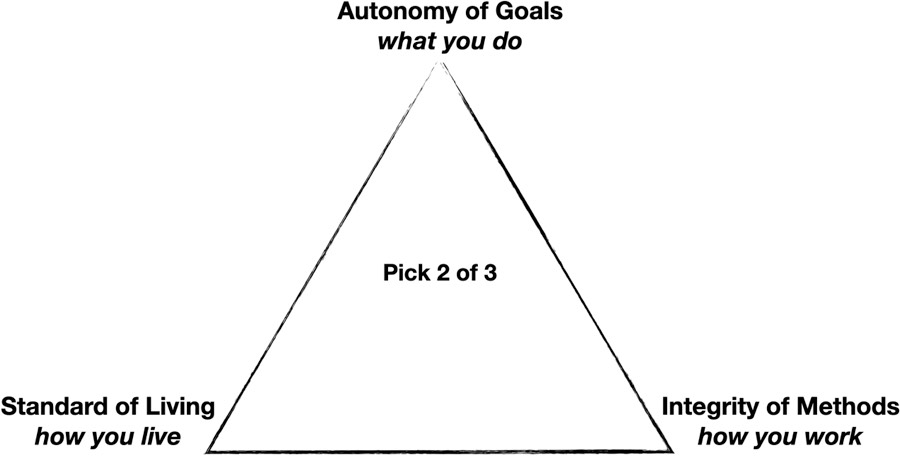
The price of freedom, from Art of Gig.
You cannot keep up the class lifestyle expected of someone doing the things you are doing. And family and friends are often the biggest sources of this anxiety because you care about them and they care about you.
But third: if you want to stay in the gig economy, you can hack the triangle! Yes, you have to pick two of three, but you don’t have to make the same choices in all situations and at all times.
my take
This chart is so good, mostly because he offers an out. It’s probably one of the best frameworks. I tend to lean toward autonomy and integrity and an unoptimized standard of living, which led to money insecurity at first. One way to hack this is to do these trade-offs for each activity. For me, I optimize for standard of living and integrity of methods for my StrategyU work. I price high and compromise on what I’m doing, but not how I work. This helps me fund stuff I don’t want to be pressured to make money on, like my writing about work.
The clutch class
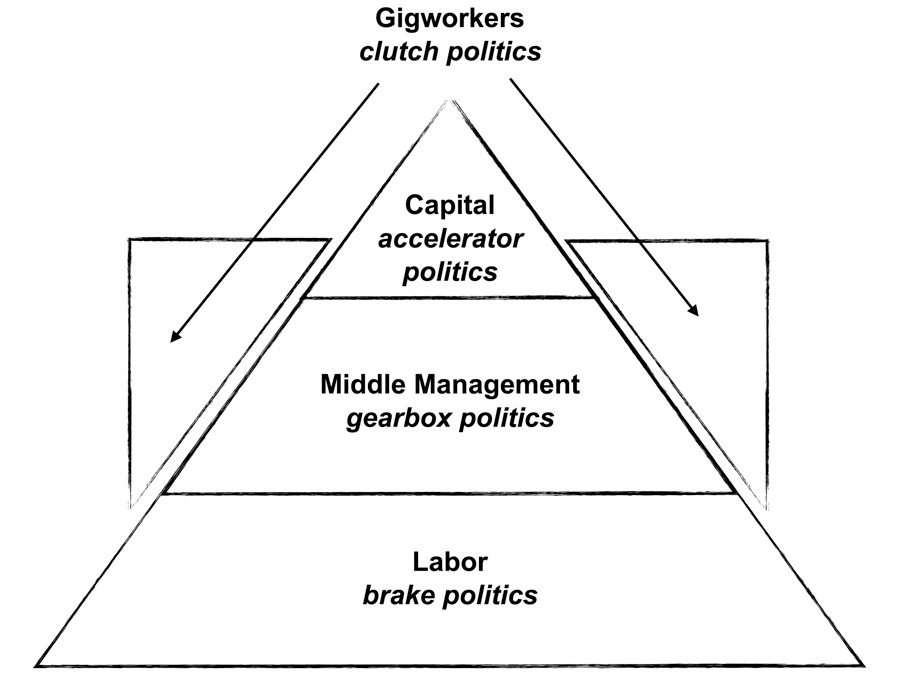
The gigworker class, from Art of Gig.
I like his idea of indies as the “clutch class.” Indies opt out of the social contract with jobs and are the “scabs” of the professional class.
No matter which way you lean in terms of sympathies, there is an objectively correct answer: we are neither labor, nor capital.
what the clutch class does on evenings and weekends, everybody will be doing in ten years.
And we sneak one-at-a-time into the future, through gaps on the economic frontier, rather than marching rank-and-file in slogan-chanting cohorts.