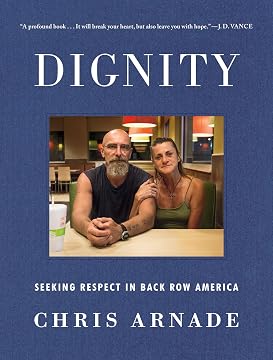
Chris Arnade has a fascinating talk about his book Dignity. He spent the last several years wandering around America talking to people who are struggling and learning about how they find dignity in their life. He calls them “back row” people, meaning they have mostly missed out on the enormous economic growth that “front row” people have been able to take advantage of.
I do recommend watching at least some of the video:
The word dignity is a powerful one. Arnade highlights it as one of the “things that give you value that you can’t measure.” The economist Russ Roberts has also been saying a similar thing but within the domain of economics:
Those things are what really make our hearts sing: pride, dignity, respect. They’re cliches, but they’re not in our model. So we say, “Well, yeah, they’re working in the background.” Or “We’re just holding them constant.” Or “They’re not important for the question I’m looking at.” Then we get to something like universal basic income, where we say, “Okay, we’re worried — because of, say, autonomous vehicles or artificial intelligence — that people aren’t going to be able to find work, but that’s okay. We’ll just give them a check.”
Arnade says the public conversations and policy debates continue to focus on success and dignity through a “front row” lens:
“the way we think about the world is through a very narrow framework that only one thing mattering: resume, education and how much money you make”
For many, this game is not a practical possibility and they look instead for “non-credentialed forms of meaning” in three forms: place (local community), religion and racial & ethnic culture.
All three of these are becoming harder to achieve and Arnade finds that people are filled with shame and humiliation - being out of work or not knowing how to get the pieces together in their life. One thing he said stood out:
“the opposite of humiliation is looking for dignity”
As work becomes increasingly fractured, we are going to need a broader lens for thinking about how people can have dignity beyond the “front row” path.
Highlights
In my new life, in the front row of the front row, it wasn’t odd at all that I had left. Here most everyone had moved multiple times and moved again for the right opportunity. Here many had grown up feeling like an outsider, stigmatized because of their political views, social views, or lifestyle. All had moved to focus on their education and find an environment less judgmental of them and their views. Here everyone was about their careers and how they saw themselves. Few rarely said where they were from, beyond what college or grad school they attended. Place was just a temporary step in a process.
I was part of a global group of lawyers, bankers, business people, and professors who are their profession first and a New Yorker, Brit, or Southerner second. They are as comfortable in New York City as they are in London or Paris or São Paulo or Hong Kong. Well, in the right neighborhoods in each.
In their minds, staying put is a mistake. If you stay, you limit your career, you limit your wealth, and you limit your intellectual growth.
They also don’t fully understand the value of place because like religion, it is hard to measure. What is the value of staying near the family that raised you or in the valley where you were born?
Had I asked those in my hometown when I visited why they stayed, why they were still there, I would have gotten the answer I heard from Cairo, to Amarillo, to rural Ohio. They would have looked at me like I was crazy, then said, “Because it is my home.”
The communities that provided pride are dying, and into this vacuum have come drugs. Their entire worldview is collapsing, and then they are told this is their own fault: they suck at school and are dumb, not focused enough, not disciplined enough.
It is a wholesale rejection that cuts to the core. It isn’t just about them; it is about their friends, family, congregation, union, and all they know. Whole towns and neighborhoods have been forgotten and destroyed, and when they point this out, they are told they should just get up and move (as if anyone can do that) and if they don’t, then they are clearly lazy, weak, and unmotivated.
Everyone wants to feel like a valued member of something larger than themselves. The current status quo doesn’t do that for most of America, because it only understands value in economic forms of meaning. In that world it is all about getting credentials, primarily those gained by education.