
I’ve been getting into cooking in the past few weeks and am excited about it, which has surprised me. For a long time, I had the story that “I probably don’t care about food enough to really get into cooking, I’ll just be efficient and cook whatever is good enough.”
Despite this, I’ve taken many small steps over the last few years to try to learn more about cooking, learning recipes from my aunt, learning knife skills, watching a couple of YouTubers, and even going through a two-month Blue Apron phase.
Yet it never quite clicked. I couldn’t find a way in to stay excited.
This changed for me in one week.
A few weeks ago, I saw this post from Myles Snider with a bunch of recommendations in his cooking newsletter.
I had originally followed him during my Blue Apron phase last year. We might call this phase “pre-excitement” where we just start randomly buying things and trying to get into things, even if we fail. I sense this is where many people give up. They take their false starts as proof that they can’t learn the thing.
I had never taken any action from any of his newsletters but for some reason, his excitement about the “Olio Nuovo,” a term for the first harvest of a season of olive oil, inspired me to instantly buy a bottle.
Over the past year, I’ve been trying to practice a form of instant action, which is my attempt to lower the time from having a thought to taking some action on it. I sense this is vital while being self-employed but it has also helped me level up my skills in DJing, Figma, Yo-Yo, and digital marketing over the last year.
I’ve also been trying to host more events and a thought in early January quickly turned into a reflection lunch for a bunch of creators in Austin. The night before the meetup a friend asked Myles to join. I had known he was in Austin but never thought to reach out.
During the lunch I mentioned I want to learn how to cook in 2023, driven by my aspiration to be able to cook good (not just butter pasta) meals for Angie after she gives birth. It sounds nice but let’s be honest, I was still talking about this with only two months to go and hadn’t taken any real action.
Myles generously offered to be my cooking sherpa. I knew this was a chance I had to take. I was ready to climb Everest despite not knowing if I’d give up at base camp.
In one coffee conversation, however, he dramatically altered my perspective on learning how to cook and I was filled with an excitement that was missing in previous attempts.
Here are a few things that I think helped shift my perspective:
- “Cooking Is Easy”: He lowered the stakes and positioned cooking as something that was not too hard to learn. This felt wrong when he said it but is actually a useful framing for a beginner that does not quite know the depths of what he is about to discover.
- Someone Who Likes Helping Amateurs Get Into Cooking: Myles genuinely loves cooking, helping others get into it, and is still learning himself. There’s something about being around people like this that always motivates me to want to follow their path.
- Narrow Focus: He suggested I limit my focus to a couple of dishes just to get good at them. This also seems obvious now but for some reason before this conversation my conception of learning how to cook involved many dishes and many ingredients. He told me to just get good at one dish I could serve to a group and cook it over and over.
- Homework: He told me to buy Kenji’s The Food Lab.
The book arrived the next day and as soon as I dove into the introduction I knew this was a huge missing piece. I’m not sure if this is a perfect book for all beginners or if I just felt like Kenji was a kindred spirit with his time at MIT, his annoying habit proclivity for questioning any and all authorities, and his need to test everything out himself.
That’s when I stumbled upon something he wrote that nearly broke my brain.
“Cooking is science.”
What the hell?! How could I have overlooked this basic fact? I had been glorifying cooking as something done by professionals in good kitchens with magical skills. You must know a broad range of spices, recipes, and advanced techniques.
Nope, just science.
Finally, I had some use for all those thermodynamics, materials engineering, physics, and chemistry classes in college.
This made me excited to learn about the materials of pots and helped me pull the trigger on a meat thermometer, stainless steel saute pan, and something called a saucier (it makes me feel damn fancy just saying this).
It made sense why Myles recommended this book too. By making fun of how serious other chefs are and how they make some basic cooking mistakes, Kenji also made me feel like I could be good at cooking despite knowing next to nothing.
Here’s the vibe: “If there are three rules that I think would make the world a better place if everyone followed them, it’d be these: challenge everything all the time, taste everything at least once, and relax, it’s only pizza.”
And this has taught me a vital lesson about trying to learn things. Don’t just try to learn the thing, find people who can show you how to get excited about it. Find a book by someone like Kenji and find your Myles.1 In other words, look for a portal into a new way of seeing the thing you want to learn.
Back to The Food Lab
Kenji is an outsider and I love it. He is driven by a deep curiosity at the beginning of his path. Here he is on questioning why things are done certain ways:
“Why do I have to cook pasta in a huge volume of water? Why does it take so much longer to bake a potato than to boil it? How come my pancakes always suck? And what’s really in baking powder anyway? I made a pact with myself then and there that as soon as I was finished with college, I’d never again do anything that I didn’t enjoy doing.”
I imagine this makes him annoying in the food world but to someone who has not worked in a restaurant all I can think is, “Yes! Those are good questions!”
And since cooking is science, I can ask questions and experiment too! Let’s go, baby.
I’ve now cooked an olive oil and garlic pasta dish four times and each time I learned a little more about heat, ingredients, the magic of butter, and using pasta water. By the fourth, I even had enough confidence to go for the white wine clam version. Looks pretty cool on our cute pink bowl plates, huh?
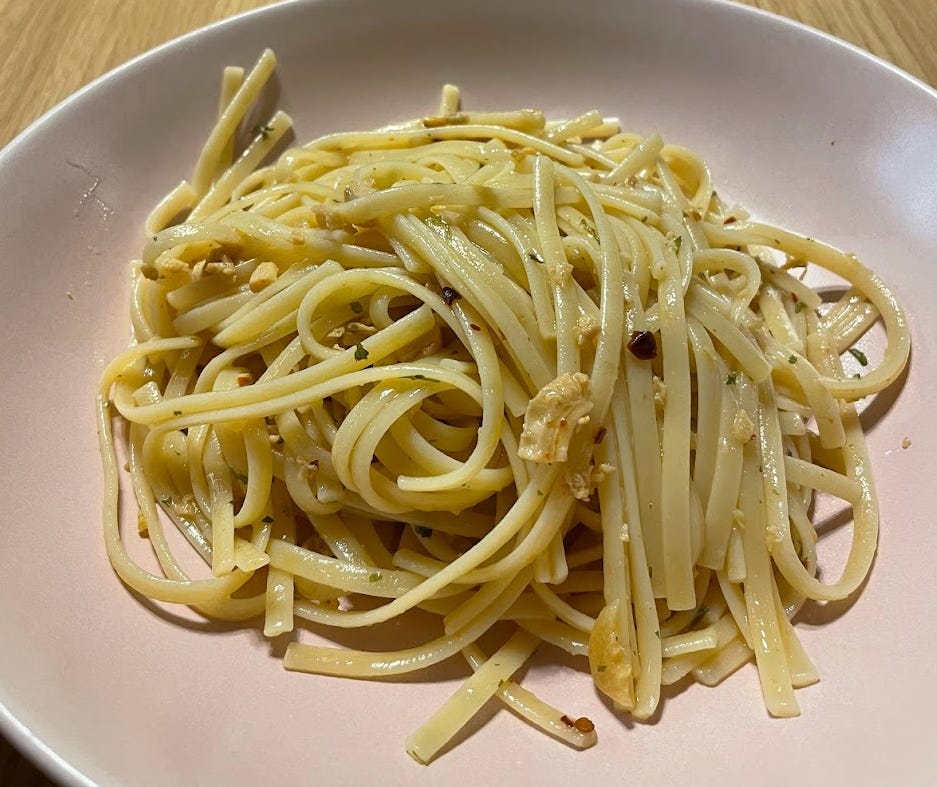
And sometimes I fucked up. But because cooking is science and I’m just trying to cook the same dishes, this is just information!
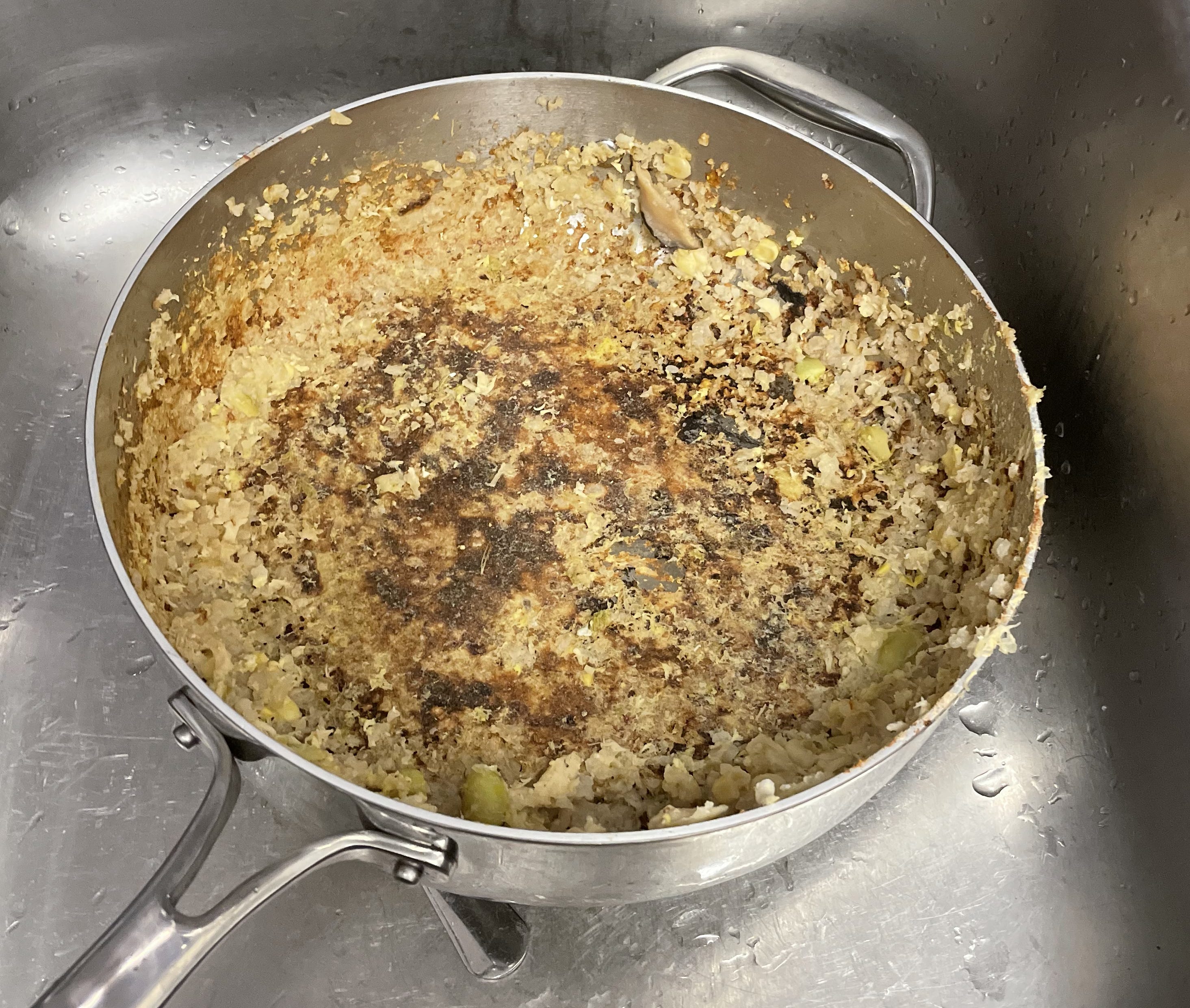
Seeing learning how to cook as a bunch of experiments has somehow lowered the bar for me dramatically and made learning to cook a very lightweight proposition.
And after two weeks I’ve accomplished the most important thing when learning things: a basic level of confidence and a clear view of a path to keep learning. This will be easy now. There is no goal to become good, just a long game of running more experiments.
While I don’t think cooking is the “real work” of my life I am excited for it to become a bigger part of it.
It was cool to read, however, how cooking definitely is the work that matters to Kenji:
“Like a head-injury patient who suddenly develops a brand-new personality, something snapped the moment my hand touched a knife in a professional kitchen. I was no longer in control of my own destiny”
What have you been holding off on learning? How can you find a new way in?