What I think
This is one of the most powerful books I’ve read. I recommend all of David Whyte’s books.
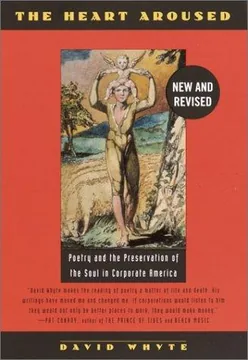
I wish I’d read this book at the beginning of my business life, but I wonder if it would have been too soon. Whyte speaks poetically about the experience of the business world in a way that, well, arouses your heart.
Discovering the beautiful language of David Whyte was a big shift for me. He seems to be able to frame the pain of modern work and the constant need to reinvent through poetry in a way that no business book or business “thought leader” ever has. When I share Whyte’s writing with people, it seems to hit a nerve at a deeper level than “I need to find a new job.”
The Three Marriages and The Heart Aroused combined awakened a new language for making sense of how I felt about work and what was missing in my life.
If you’re feeling distraught in a job, read The Heart Aroused. It will probably resonate most if you’ve worked in the corporate world.
What the book is about
Whyte wrote the book in the 1990s for people working inside corporate America who are trying to hold on to their humanity. He brings poetry, from Beowulf to Coleridge to his own poems, into the world of managers and careers. He uses it to explore fear, failure, voice, midlife, and the parts of ourselves we give up for safety, arguing that work needs a place for both strategy and soul.
Highlights
Why he wrote it
The Heart Aroused is written for those who have chosen to live out their lives as managers and employees of postmodern corporate America, and who struggle to keep their humanity in the process.
Despite everything our inheritance may tell us, work is not and never has been the very center of the human universe; and the universe, with marvelous compassion, seems willing to take endless pains to remind us of that fact.
The point is to make an equal place in the psyche for both strategy and soul.
Looking a little foolish
As he reinvented himself as a poet in his 30s:
Anyone not prepared to look a little foolish now and again would be better not starting this path.
The fear of leaving a path that makes sense
We experience a form of internal sticker-shock, that the price of our vitality is the sum of all our fears, that the price of our passion and commitment involves the shattering of deep personal illusions of immunity and safety.
We might at first label the body’s simple need to focus inward depression. But as we practice going inward, we come to realize that much of it is not depression in the least; it is a cry for something else, often the physical body’s simple need for rest, for contemplation, and for a kind of forgotten courage, one difficult to hear, demanding not a raise, but another life.
The path we can see is not our path
In effect, if we can see the path ahead laid out for us, there is a good chance it is not our path; it is probably someone else’s we have substituted for our own.
Finding the work that seems worth doing
As the fire of our creativity burns its way into our interior life as much as it transforms the world at large, we experience what the medieval philosophers called the alchemical wedding, the meeting of the interior world of a single human being with the great soul of the world.
At that center we work because we love our work, and we love our work because we have chosen the right work, the work to which we belong.
Embracing how life is
Without the fiery embrace of everything from which we demand immunity, including depression and failure, the personality continues to seek power over life rather than power through the experience of life.
Saying no as a form of faith
The via negativa is the discipline of saying no when we have as yet no clarity about those things to which we can say yes. We take the via negativa when there is not yet any sign of the via positiva. But in the continuous utterance of the no is a profound faith that the yes will appear.
The costs of good sense
Many of us can look back on our own youth to a company of friends who showed great promise and gifts and were one way or another slain by the adult world.
Banishing our innocence in the name of safety and good sense, we find that our capacity for vitality and enthusiasm is lost.
Leaving the magnificence of the world outside the door, we also leave any desire to really live in the world.
A longed-for increase in salary brings no financial breathing space, but a larger house with the extra burden of its mortgage.
Retirement
Many who leave work prematurely after a lifetime of toil have no idea how to spend their later years. Time stretches before them like a desert. They suffer a form of deep amnesia compounded by the neglect of their own instincts.
Paths, chaos, and edges
Most paths, in fact, metaphorical, literal, or mathematical, take the form of an iterative equation, an equation where the values and events it produces are continually fed back into the equation again and again, influencing any future values it may throw out.
Modern “managers” might be better dropping the title of manager itself and, following the dynamics of complexity, discover in the process that natural systems tend to move toward and find their most vital form at the boundary between chaos and order.
It is astonishing to witness the human ability to shrink from this edge and take on every possible kind of experience in an ordered, burdensome way
These boundaries, however, should always be tested to see if they are actually still real.
Rest and being lost
Rest, as we all know, brings perspective, vitality, and good humor. But it also brings a relaxation into inner silences and images that are sometimes too difficult to face. We might wonder if this has anything to do with our addiction to being busy.
The marvelous peculiarity about admitting to being lost is that we come to our senses. We wake up. We look around with a keenness we did not have before.
Desire
But I also do not believe we can interpret service as the complete surrender of personal desire. It is exactly through desire that we discover what animates and moves us.