
This book is like the advanced Pathless Path. It goes into so much detail and thought around the different phases of life transitions that I ended up stopping and writing this post.
Almost Everyone Is Getting Thrown Off Course
The interesting thing is how noticeable this is after leaving a conventional path. Even if it is only a few comments, the skepticism is so consistent that you sometimes think you really are doing something wrong. Over time you realize that it’s about other people, all of whom are saying the same thing: “suffer like me and I’ll leave you alone but veer off course and I’ll make you pay for my discomfort.”. This was bizarre to experience but also made me curious. Eventually, I realized most people weren’t judging me, they were projecting their own insecurities and fears onto my life choices.
I’m reading an amazing book right now that offers a helpful reframe. It’s called Life Is in the Transitions by Bruce Feiler (recommended by Aida Alston in our conversation about this). Feiler argues that most people think of life as a smooth linear path. If you ask most 21-year-olds, including me at the time, you’d probably get them telling you this is how life will go. After all, this is what almost every company recruiting college graduates tells you.
Despite our hopes that the linear path is real, Feiler’s extensive research into people’s lives found that the reality was much different. Instead of being defined by a line, people’s lives are shaped by a steady stream of “disruptors.” Most people have about three dozen disruptors in their lives, meaning on average people face things that send them in new directions every 12-18 months.
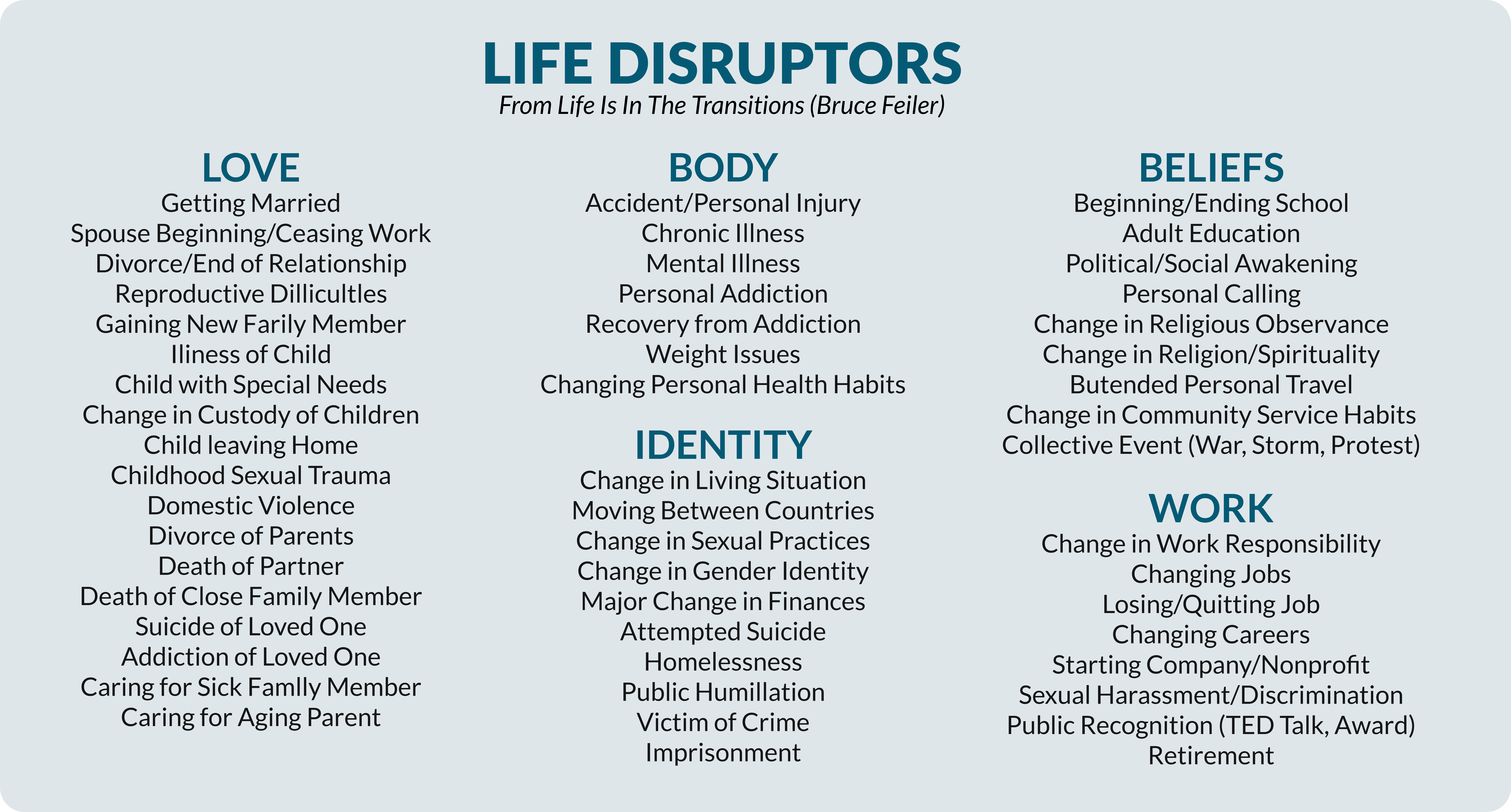
Start taking an inventory of your life and you’ll see that your life is full of disruptors. Graduating from school, starting a new job, getting fired, moving locations, starting a new relationship, ending a relationship, health challenges, and so on. Live long enough and they are inevitable.
The danger, especially in today’s cultural zeitgeist, is to turn ourselves into victims. But for me, Feiler’s perspective is freeing. The more interesting perspective for me is something closer to:
Almost everyone is getting thrown off course almost all the time and we should just stop pretending like we are living a smooth existence.
A false belief in my own life as a smooth path toward adulthood set me up to get rocked when I had a bunch of disruptions in a two-year stretch at the age of 25: losing my grandfather, starting grad school, starting to date someone, ending grad school, getting dumped, starting a new job and then losing my health.
Feiler calls this kind of thing a “lifequake” - when a series of disruptors force you in a new direction whether you want it or not.
Adult “Leaps”
This week I learned about something that babies experience about eight times in their first year: “leaps.” A leap is a period of rapid development, which can be a bit overwhelming. They feel as if they’ve woken up in a new world with heightened senses and when this happens they require a bit more comfort than normal.
Isn’t this what so many of us experience in adulthood too? When I left full-time work I had the feeling that I had entered a new reality. I was disoriented and saw things from a new perspective. Walking around Boston that fall it was as if I had installed a new software upgrade and hadn’t quite gotten the hang of things. I wondered how a simple change in my relationship with work could change everything.
How many people are going through “leaps” in their life right now? When people change jobs, relationships, or move, they enter a new reality. In Life Is in the Transitions, Bruce Feiler argued that this is what life is like - a series of disruptions that we are constantly adapting to. He calls them “disruptors” and estimates that most of us will experience 30-40 throughout our lives.
But many people deny this by failing to notice how much things are shifting all the time. Or by clinging to outdated stories of the linear life path. And this might be an adaptive response because if you’re the one deciding to leap, you may not find many people willing to comfort you. Better to pretend everything is okay than signal that you are on shaky ground.
But what if we looked at adults a little more like oversized babies? Could we stop pretending a little? Could we look at others and wonder how we might help them find their footing on new terrain? Would it potentially help us dream a little bit bigger about leaning into the change that will inevitably join us on our journey?