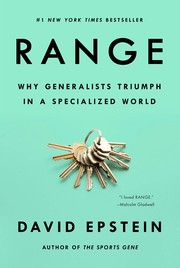
I’m reading Range by David Epstein which has a lot of great stories about people that didn’t follow a path of specialization. His argument is that while focusing early and staying on one path can be effective, being a generalist can be better in the long run.
Here is the challenge he outlines:
The challenge we all face is how to maintain the benefits of breadth, diverse experience, interdisciplinary thinking, and delayed concentration in a world that increasingly incentivizes, even demands, hyperspecialization.
Some quotes I highlighted:
On improvising and self-criticism:
Limb saw that brain areas associated with focused attention, inhibition, and self-censoring turned down when the musicians were creating. “It’s almost as if the brain turned off its own ability to criticize itself,” he told National Geographic. While improvising, musicians do pretty much the opposite of consciously identifying errors and stopping to correct them.
On how effective learning strategies involve taking a short-term backward step:
In 2007, the U.S. Department of Education published a report by six scientists and an accomplished teacher who were asked to identify learning strategies that truly have scientific backing. Spacing, testing, and using making-connections questions were on the extremely short list. All three impair performance in the short term.
This quote from Olympic figure skater Sasha Cohen was powerful:
“Yes, striving to accomplish a single overarching goal every day means you have grit, determination and resilience. But the ability to pull yourself together mentally and physically in competition is different from the new challenges that await you. So after you retire, travel, write a poem, try to start your own business, stay out a little too late, devote time to something that doesn’t have a clear end goal.”
Wander a little my friends…
More highlights
Learning slowly
One of those desirable difficulties is known as the “generation effect.” Struggling to generate an answer on your own, even a wrong one, enhances subsequent learning. Socrates was apparently on to something when he forced pupils to generate answers rather than bestowing them. It requires the learner to intentionally sacrifice current performance for future benefit.
Metcalfe and colleagues have repeatedly demonstrated a “hypercorrection effect.” The more confident a learner is of their wrong answer, the better the information sticks when they subsequently learn the right answer. Tolerating big mistakes can create the best learning opportunities.
Match quality
“Match quality” is a term economists use to describe the degree of fit between the work someone does and who they are—their abilities and proclivities.
For professionals who did switch, whether they specialized early or late, switching was a good idea. “You lose a good fraction of your skills, so there’s a hit,” Malamud said, “but you do actually have higher growth rates after switching.” Regardless of when specialization occurred, switchers capitalized on experience to identify better matches.
Ogas uses the shorthand “standardization covenant” for the cultural notion that it is rational to trade a winding path of self-exploration for a rigid goal with a head start because it ensures stability. “The people we study who are fulfilled do pursue a long-term goal, but they only formulate it after a period of discovery,” he told me. “Obviously, there’s nothing wrong with getting a law or medical degree or PhD. But it’s actually riskier to make that commitment before you know how it fits you. And don’t consider the path fixed. People realize things about themselves halfway through medical school.”
First act, then think
Ibarra concluded that we maximize match quality throughout life by sampling activities, social groups, contexts, jobs, careers, and then reflecting and adjusting our personal narratives. And repeat. If that sounds facile, consider that it is precisely the opposite of a vast marketing crusade that assures customers they can alight on their perfect matches via introspection alone. A lucrative career and personality quiz and counseling industry survives on that notion. “All of the strengths-finder stuff, it gives people license to pigeonhole themselves or others in ways that just don’t take into account how much we grow and evolve and blossom and discover new things,” Ibarra told me. “But people want answers, so these frameworks sell. It’s a lot harder to say, ‘Well, come up with some experiments and see what happens.’”
Instead, she told me, in a clever inversion of a hallowed axiom, “First act and then think.” Ibarra marshaled social psychology to argue persuasively that we are each made up of numerous possibilities. As she put it, “We discover the possibilities by doing, by trying new activities, building new networks, finding new role models.” We learn who we are in practice, not in theory.
The executive would only consider it if the consulting firm McKinsey thought it was a good idea. “McKinsey’s opinion,” Bingham recalled, “was, ‘Who knows? Why don’t you launch it and tell us the answer.’”