“I think you have an issue with money.”
This was after a podcast conversation with someone who was making a lot of money running their business. We weren’t even talking about the topic, but the comment still seemed to have some truth in it that I didn’t know how to respond to.
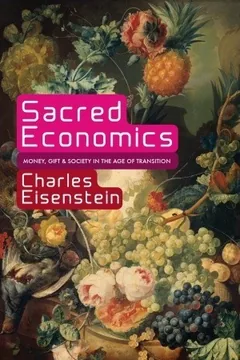
In 2017, I read Charles Eisenstein’s Sacred Economics, which shook me up a bit and probably “cost” me tens of thousands of dollars of earnings as I explored a new relationship with money through gift economy experiments.
The book is an exploration of new economic models but also a nerdy dance with some of the challenges of our modern world. Eisenstein points out the paradox behind the idea of being “independent”:
we are self-sufficient in relation to the people we know but dependent as never before on total strangers living thousands of miles away.
What made the book resonate was his avoidance of blame. He points out, I think accurately, that our modern angst is a result of an underlying complexity that is hard to comprehend:
I think ultimately what is happening is that our deep ideologies and belief systems, and their unconscious shadows, generate a matrix of synchronicities that looks very much like a conspiracy. It is in fact a conspiracy with no conspirators. Everyone is a puppet, but there are no puppet-masters.
As a possible path towards a “new story” he shares the idea of a “gift economy.” The central idea is that transactions create a sense of separateness and that giving a “gift” is a way to disconnect from the expectations that many of us have tied up with work (“we need to get paid for what we do”).
Charles’ book inspired me to experiment with the gift economy in 2018, which I’ve written about before. Those experiments made me more comfortable with my money emotions and also helped me think about how I can find ways to give while also finding other ways to make money and support that giving.
Back to the comment. I think that person was right. I did have issues with money. I saw taking money as something that would compromise my desire to create. I felt a little guilty that I used to make so much money in my former job.
Fellow corporate escapee Khe Hy offers a question, “Why do you make money?” to his clients. Many people come up with 3-4 quick answers, but struggle to find ten.
I think we all could grapple with money a bit more and contemplate its hold on us. Many people avoid this question and play the game of making enough so they never have to think about it. Self-employment seems to force this contemplation. A lot of what I’ve found resonates with this quote from another self-employed person, Ritika:
You’re more relaxed, you realize you didn’t need so much in the first place, you learn how to make do with less, and most importantly you’re way more creative and inventive with your work and funds.
At the end of the day, true wealth for me is having people that love you and will take care of you when shit hits the fan.
Two years later: unlocking generosity
I came back to the book in the newsletter in May 2021:
Over the last few months, I’ve made a number of direct cash contributions directly to individuals. This builds on a trend of giving away a lot more money in the past few years both in absolute terms and as a percentage of my income and in ways where I don’t give in order to get a tax write-off. I want to make an argument for more people to participate in such acts and explore how our beliefs about money and work might be keeping us from acts of generosity that might make our lives better and more fun.
The way I thought about giving when I started my career was to set aside a small percentage to “worthy causes.” This usually meant institutions like non-profits, educational institutions, and other “legitimate” organizations. I realize now that it’s easier to funnel money through middlemen than give it directly to people because of how we think about money.
My mindset shifted after reading Charles Eisenstein’s Sacred Economics. In the US we default into a competitive consumer mindset, making sure you get paid your worth, find the best deal, “get your money’s worth,” and take any and all steps to avoid getting ripped off or wasting money, which Eisenstein highlights in his book:
In our society we are accustomed to constantly being targeted for the sale. In the world of marketing, we are consumers to be fleeced, objects to be manipulated. Of course then, we unapologetically seek the best deal whenever we can.
From this starting point, it makes sense that we have a hard time doing two things:
- Giving money without expectation directly to people
- Receiving money from anyone without owing them something back
A marker for success for many people is to declare that they don’t have to rely on anyone. What this really means in today’s world is that they can hire others to do things for them or buy stuff made by people in factories located across the world. The problem with this goal is that you might achieve it and your life becomes an act of asset allocation and scheduling rather than the things that give life meaning.
This is hardly an argument against capitalism. You won’t find that here. But instead, an argument that at the edges we might lean against some of these deeply embedded scripts that are the result of how our economy works and consider experimenting with giving money away in ways that make our life more interesting.
Many of us have gift relationships with our immediate families where keeping an accounting ledger of expenses would seem absurd. However many of us are afraid to take this approach with most other people in our life. I think this is not because we don’t like being generous but because we have enormous expectations and hang-ups about how we think about money. At its best generosity comes with expectation and is not free of it.
Here is Eisenstein again:
One thing that gifts do is that they create ties among people — which is different from a financial transaction. If I buy something from you, I give you the money and you give me the thing, and we have no more relationship after that. I don’t owe you anything, you don’t owe me anything. The transaction is finished. But if you give me something, that’s different because now I kind of feel like I owe you one. It could be a feeling of obligation, or you could say it’s a feeling of gratitude.
When I read this quote I think about Noel, Jordan, and Mike, and their unexpected generosity throughout my journey. Their monetary gifts always seem like much more than a small payment. They were both an invitation to a deeper relationship and a way of them saying “keep going, I believe in you!”
Giving in Mexico
When I was in Mexico we got to know a local chef, Pepe. We met him when we moved into our friend Jonny’s house, who had hired him a month earlier when he was struggling to find work. When we were about to move out I knew that he was desperate to keep making money and I promised him that we would still work with him. During that time the relationship also shifted from a friend to someone that I’d consider part of my gift circle. He was a friend.
That following month, I asked him what his dream was. He said he wanted to make cooking for people a sustainable thing. I told him I wanted to help him make that happen. I bought him a proper knife, helped him build a website, develop a menu of services, took professional pictures and a video, and helped him with some basic business 101. I also gave him his first “paid vacation days” of his life, giving him 3-4 days off, paid. When the month was over, Angie and I were moving into our own apartment and told him we didn’t want to keep using a chef and I could tell that he was a bit worried about money.
As the end of the month approached, he needed repairs on his bike and didn’t have the money to cover it. My friend Travis stepped up and offered to give him cash. I offered some as well. This was positioned as a loan but we both knew it likely wouldn’t be paid back and that was okay. Despite our willingness to help, both of us still had to fight off our old scripts, clinging to an idea of how we wanted him to react to the money. This is the challenge with giving. We have all sorts of emotions and expectations tied up with how we think people should live, save, spend, and appreciate things.
Part of why I wanted to stop working with him was that I believed in him. He was clearly a good cook and thought he could succeed without our support. Within a couple of weeks, Pepe landed his first gig, doubling the pay that we had been paying him and I could tell something had been unlocked. As I came back to Taiwan he kept sending random pictures. New business cards, falafel, and hummus he started selling at a local store, his new brand, and logo, and then this last week, he opened a restaurant.
Although I didn’t have any expectations of monetary return, I did have hopes that Pepe would find his confidence and see how talented he was. My expectation was that he bet on himself and he surpassed this by a mile and it’s been fun to watch.
This is to say that gift-giving is not about learning to give without any expectation, it’s to give in a way that it aligns with a genuine caring about other people.
Questioning our default scripts around giving
I’m not writing any of this to brag to you but to make the case that being more generous, expanding our “gift circles,” and finding ways to give directly to people without any attachment to how they react to the money or spend it, we might make our lives more meaningful and interesting.
Consider the following questions. What if you:
- Gave 5x what you are comfortable with to someone?
- Abandoned the idea of an inheritance or lower your goal of retirement savings by 10% and instead invest that money in people, causes, and learning in ways that might lead to interesting results
- Help pay a bill in someone’s life that might be having a hard time?
- Give money directly to people who might squander it in ways that will frustrate you just to see how it feels?
- Volunteer your skills to help someone on something you might charge for?
I think we are in the early days of an inevitable explosion of one-to-one generosity and a shift in our beliefs around money. Loss of faith in institutions tied with technological tools where everyone will have some form of public digital wallet will make it such that sending money to people directly will become normal.
Most people are tied to the idea that money needs to be “earned,” by hard work. There is value in this belief as it motivates people to contribute to society but it underestimates how much people are driven to do so without any incentive. This belief likely hardened in the 1900s as a sort of cope to deal with the fact that most people had to sell their time for a paycheck and do work that they didn’t like. It’s still useful but not as the only lens through which we look at money and work.
Work is much better for most people but we still think that we need to suffer to earn. The problem with this is that we might actually destroy our passion for life along the way. We treat others as if they are consumers rather than friends. We are afraid to give because “what if we get taken advantage of?” or “what if someone wastes the money?” A gift mindset transcends these fears and morphs that question into “what kind of commitment can I make to support someone else?”
I’m interested in helping people discover the creativity, passion, and work that brings them alive. If a small or large gift of money can play some part in that I’m interested in exploring how I can experiment with doing so before I reach some level of wealth. Let’s not let our outdated work beliefs keep us from creating deeper bonds and betting on each other while making life more interesting and fun along the way.
Charles offers Sacred Economics in the spirit of the gift, here.
Highlights
Money and its limits
The cheap stuff that fills our lives today, however great its quantity, can only cheapen life.
Money depersonalizes a relationship, turning two people into mere “parties to an exchange” driven by the universal goal of maximizing self-interest.
This idea has ancient roots going back to Aristotle, who distinguished between two kinds of wealth-getting: for the sake of accumulation, and for the sake of meeting other needs. The former kind of wealth-getting, he says, is “unnatural” and, moreover, bears no limit.
As Aristophanes said, in all things—bread, wine, sex, and so on—there is satiety. Our needs are limited, and when we have fulfilled them, we turn to other things and are moved to generosity. “But of money, there is no satiety.” It is not the propensity to consume that bears no limit; to the contrary, limitless desire arises with money. After attaining a surfeit of consumables, people covet money itself, not what it can buy, and this desire has no limit.
”I don’t need you”
Consumption calls upon no one’s gifts, calls forth none of anyone’s true being. Community and intimacy cannot come from joint consumption, but only from giving and cocreativity.
We don’t want to receive gifts because we don’t want to be obligated to anyone. We don’t want to owe anybody anything. We don’t want to depend on anyone’s gifts or charity—“I can pay for it myself, thank you. I don’t need you.”
As Mauss puts it, “To refuse to give, to fail to invite, just as to refuse to accept, is tantamount to declaring war; it is to reject the bond of alliance and commonality.”
Living in the gift
In right livelihood, then, I suggest that we orient ourselves toward our need and desire to give. I suggest that we look at the world with eyes of, “What opportunity is there to give?” and “How may I best give of my gifts?”
If you still have money to invest, invest it in enterprises that explicitly seek to build community, protect nature, and preserve the cultural commonwealth. Expect a zero or negative financial return on your investment—that is a good sign that you are not unintentionally converting even more of the world to money.
And even though you may feel some sense of being ripped off, of living the life someone is paying you to live but not your own life, the life of a slave compelled to work or to die, that doesn’t mean you “should” overcome your fears and quit that job and trust you’ll be OK. Living in the gift is not another thing you are supposed to do in order to be a good person.
When the accumulation of wealth is no longer of high social importance, there will be great changes in the code of morals. We shall be able to rid ourselves of many of the pseudo-moral principles which have hag-ridden us for two hundred years, by which we have exalted some of the most distasteful of human qualities into the position of the highest virtues. —John Maynard Keynes