What I think
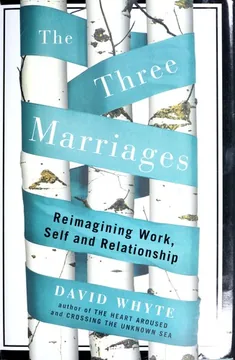
This is probably the book that has had the biggest impact on me. There is only before and after David Whyte in my timeline.
I read it a year into self-employment, and Whyte’s writing tapped into the question that had been lingering in my mind that entire year: who am I if not a worker?
Most of what I’d read about work was about hyper-success or starting a startup. Whyte cut across all of that. He wrote about the lived experience of work and life, and his language enabled me to soften into the world. I became more open to uncertainty and sensed there was something larger to be found, something that couldn’t be articulated.
It’s a warm hug for the soul about what matters in life. I’d recommend it to anyone who wants a bigger and more expansive vision for their life.
How I found it
In the summer of 2018, I went to the World Domination Summit in Portland. I went because I needed friends. I only knew two or three people on unconventional paths.
That’s where I met Jonny Miller. We hit it off instantly, connecting over our shared uncertainty, our burnout, and our interest in building a life beyond the default path. The day after we met, he walked up to me and handed me his copy of The Three Marriages. He said, “You have to read this.”
In my first year of self-employment, I’d freelanced at the beginning, done well, and eased back as soon as I’d made enough. That’s when I started writing, podcasting, and doing things for the sole reason that I enjoyed them.
It felt scandalous. I was grappling with the idea that if I didn’t produce or make money, I wasn’t a good person. I hid much of what I was doing and got defensive when people asked about my path. The only models I had for thinking about work and success were analytical and rigid.
Then I flipped to page 164:
part of the burden of depression can be the constant sense of not knowing. It can be a release then, to think, that when we first come across the idea of a pathless path, by definition, we are not meant to understand what it means
I experienced it as a deep release of tension. For the first time, I had a way to make sense of what had happened with my life. It gave a phrase to something I’d been feeling in my body but couldn’t articulate.
I started using the phrase in conversations. Angie loved it early in our relationship, and when we got married, she made us a journal with “The Pathless Path” on the cover. A few years later, it became the title of my first book.
What the book is about
Whyte describes three marriages: to our work, to another person, and to ourselves. Each is a relationship that develops over time, asks something of us, and can change who we understand ourselves to be.
He weaves historical examples, personal reflection, and poetry together to argue for rethinking our work, relationships, and self. His challenge to work–life balance is that these marriages can’t be understood by dividing our time among competing demands. How we relate to one affects the others.
Highlights
On work
The current understanding of work-life balance is too simplistic. People find it hard to balance work with family, family with self, because it might not be a question of balance. Some other dynamic is in play, something to do with a very human attempt at happiness that does not quantify different parts of life and then set them against one another.
Concentrating on paying the bills will only get that young man a job and keep the lights on, but following that other light he knows well and has known well all his life will create a vocation that will embolden him to sacrifices that will pay for everything that is necessary.
When I shared this in my newsletter in July 2018, I called it a strong point of view on work.
we must make ourselves findable by being seen
We can choose a work on a mere strategic, financial basis but then we should not expect profound future happiness as a result
A real work, like a real love, takes not only passion but a certain daily, obsessive, tenacious, illogical form of insanity to keep it alive
In building a work life, people who follow rules, written or unwritten, too closely and in an unimaginative way are often suffocated by those same rules and die by them, quite often unnoticed and very often unmourned.
On marriage
The young want independence until they glimpse the ideal marriage of their imaginations
A marriage is creatively destructive of both partners’ cherished notions of themselves…Both are left with the actual marriage: a radically new conversation that is built on the razed foundations of their former identities.
Do some people never get to this point?
One of the tests of finding the right person is to ask ourselves if this is the particular form of selfishness and egotism we can live with
On the self
I thought of how much time human beings spend in circumstances they would never willingly choose for themselves
Fall in love with your own questions so that you can commensurately be disappointed by them at a later date
Our highly evolved ability to worry…gave us the ability to sit beneath a magnificent sky and not see a single star
The big, big question is: Can you cultivate a daily discipline that simply doesn’t need all this trauma in order to open the door and keep it open?
Only those who put more energy into self-pity than into paying attention are truly marooned
On the pathless path
In The Pathless Path, I wrote that to Whyte, a pathless path is a paradox:
We cannot even see it is there, and we do not recognize it.