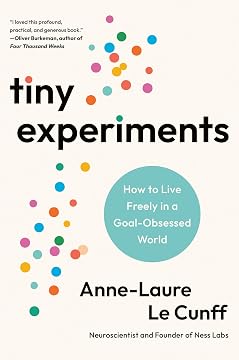
My friend Anne-Laure Le Cunff has a book out, Tiny Experiments. If I were to describe it in a fun way, it’s like if Atomic Habits decided to blow up its life and embarked on a pathless path.
My favorite part was the intro, where she brings alive her journey from leaving the default path to a false start, founding a company, and her unique journey of combining writing online with a neuroscience PhD.
This passage especially resonated:
Separated from San Francisco by thousands of miles, I finally let myself realize how I actually felt. Work wasn’t terrible, but it wasn’t great, either. I was burned out, but that was just a symptom of a deeper problem: I had become so consumed by the relentless grind that I no longer thought about what I truly wanted from each day or my future. Despite this relentless grind, I was also finding myself bored. While I had spent my younger life guided by a genuine yearning to learn and grow, I was now following a prescribed path trodden by so many colleagues before me.
Realizing how I felt was like an electric shock. Many people are able to build a rewarding, balanced life on the foundation of a job at Google. I was not one of them.
On my first day back in the office after the holiday, I quit.
How Do I Actually Take Action?
You may live a dream life, but whose dream is it?
Anne-Laure’s book is my favorite book to recommend to people embarking on a pathless path, especially before leaving. People often ask me, “How do I actually take action moving onto an unconventional path?” Her book also resonates because her path is so similar to mine. She also left a prestigious job, at Google. She obviously could have made a lot of money and just been set for life, but she walked away, created online, tried to find her people, and is now piecing together a pretty interesting collection of activities, including work in academia, writing a book, and doing other things online.
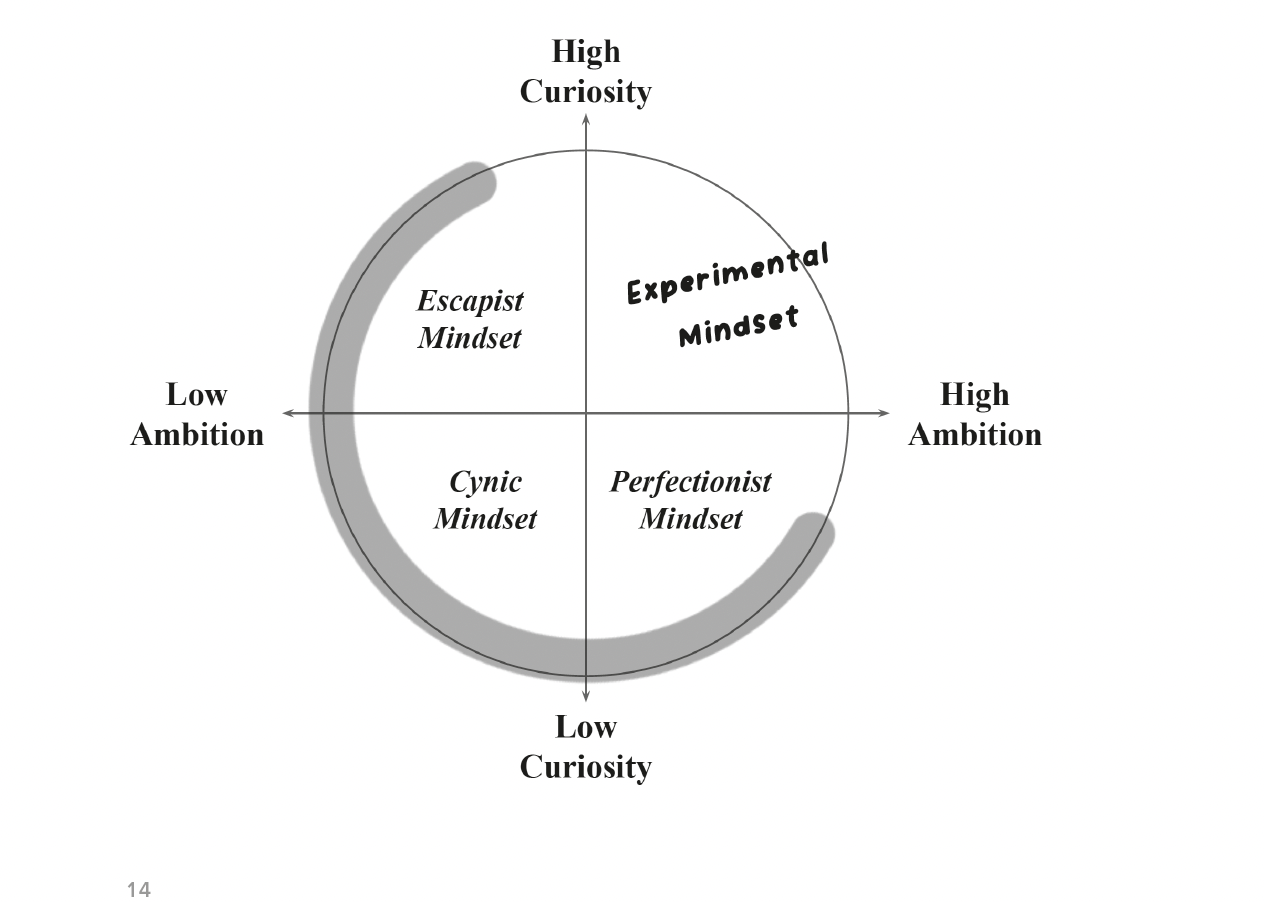
While the beginning is very personal, it shifts more to the practical throughout the rest of the book. She breaks down what an “experimental mindset” really means, including how to question the scripts in your head, come up with short-term experiments, and rejecting traditional goals. Here’s her 2x2:
We All Have This Deep Desire for Growth
I love how she challenges ambition:
But ambition isn’t broken. It is still what it has always been: the innate human desire for growth, a desire that is both universal and highly personal. People aren’t broken, either. They still crave creativity and connection. It’s the way we set goals that’s broken.
For a long time I had a challenging relationship with ambition, something I’ve written about in my second book, Good Work. I’ve come to a similar conclusion, believing that we all have this deep desire for growth. The challenge for many people is that their desire for growth does not fit into what the economy in their country provides that also happens to map to their specific capabilities, skills, and interests. I’ve found it incredibly useful to acknowledge this tension and disconnect rather than trying to think everyone can perfectly fit themselves into what the economy wants.
We assume that being ambitious means following a pre-written script and climbing a never-ending ladder, sometimes at the expense of other people.
Creating Pacts to Do Tiny Experiments
Anne-Laure and I landed on similar approaches to testing out new things. I think there is a certain kind of person for whom big goals or singular quests just don’t quite work. I’ve called my approach ship, quit & learn, but “tiny experiments” is a far better phrase for what I’m talking about.
Basically, it’s just getting yourself to take action without any expectation of it going anywhere, with the sole goal of trying to learn something from that action.
Her central suggestion is creating a pact with yourself, which is a simple phrase:
The final step is to turn your hypothesis into a pact—an actionable commitment you will fulfill for a set period of time. A pact is a simple and repeatable activity that will inevitably bring you closer to achieving your authentic ambitions, regardless of the actual result of each trial. It follows a simple format:
I will [action] for [trial period]
That’s why “I will learn how to code” is a flawed pact, but “I will code every day for a hundred days” is a great one. Instead of “I will write a book,” try “I will write every weekday for the next six months.” Replace “I will run a marathon” with “I will run every Sunday for six weeks.”
What experiment could I run on my own life that would bring me an intrinsic sense of fulfillment, whatever the outcome?
For an entire year, my pact was to devote at least five hours per week working on this book. It often ended up being many more hours, but I designed it this way because it was more flexible than a daily pact (e.g., “one hour per day”) and allowed me to shift things around in my schedule if needed.
Fear Becomes a Quiet Companion
I like how she talks about fear because I’ve experienced very much the same thing:
The fear will never be completely gone, but it becomes more like a quiet companion than a cruel bully. You might even start to welcome the fear as a sign that you’re about to do something you care about.
At first, fear was a loud voice in my head telling me not to do anything, or reminding me that I should be ashamed of doing things that didn’t fit into the story I was living out in my life or what people around me expected. But like hers, it’s become a quiet companion that is just along for the ride.
As I write in Good Work:
If fear is always a companion, it is futile to push it away. If uncertainty can never be solved, you have more freedom in terms of how you choose to spend your time and which risks you take. If insecurity is always present, wholeheartedly committing to the work that matters to you becomes much more sensible. And if doubt creeps in, you can welcome it: “Oh it’s you, the doubt monster? Nice to see you again!” This shift in perspective emboldened me. If the journey of good work means I might feel somewhat inadequate, so what? As the poet Robert Frost wrote, “The best way out is through.”
I’m still afraid of things. I still get nervous about posting articles. I get terrified of putting books out there. But the more you actually experience the criticism and skepticism from others, the more you realize that it will never actually go away, and you can never please everyone. The upside of putting yourself out there and trying new things is that you attract new people who support you, which leads to relationships far beyond what you expected.
Coming Alive Over Getting Ahead
Her challenge of asking what makes you come alive is a great question. On the pathless path, my mantra has been “coming alive over getting ahead.” It’s a reminder to get back into my body, check in with what I’m actually drawn to be doing, and question anything that promises I will be taken care of in the future. The promise of building a life around tiny experiments is that you have the freedom to adapt and evolve as the world changes, something you cannot stop.
In the liminal space called life, we are in perpetual transition from one identity to another, from one question to the next, a succession of twists and turns, each an opportunity to learn about the world and connect with others. Success is the lifelong experiment of discovering what makes you feel most alive.
I’ll genuinely recommend it to many people. It’s by far the best how-to companion for people who loved The Pathless Path.
More Highlights
Someone asked, “How’s life?” Such a trivial question, and yet … When I automatically replied that work-is-great-and-San-Francisco-is-nice-thank-you, I noticed for the first time how inert my voice sounded.
When we fixate on finding one singular purpose, we rule out the side quests that help us grow the most.
Your life doesn’t need to follow predictable acts and arcs. The best stories are full of surprises, with colorful characters and unexpected plot twists. To avoid recycling old stories, we need to break free from the scripts we write for ourselves.
Kairos moments, like pêche à pied, are what I call magic windows: those periods of creative flow that often occur when we are immersed in activities that capture our full attention, when we spend time with loved ones, or when we are engaged in self-reflection.
However, to equate stasis with failure is a modern invention and a cultural myth.
Yet for someone on an unpredictable, nonlinear path, this kind of thinking can be self-defeating. After all, legacy is the most extreme kind of end game to set your sights on, since it happens after your end.
But you are here right now. To live a good life, contribute good ideas, and nurture good relationships—that’s ambitious, too.