I wanted to share Andrew Taggart’s most complete talk to date on the concept of “Total Work.” In many ways, his article in Aeon a year and a half ago first proposing this idea sent me down a bit of a rabbit hole and has awakened my curiosity of how we got here in the first place.
In the beginning of the talk he proposes that a number of elements make up our modern conception of work and that the only explanation for these factors is a deeper idea that keeps them going.
Tasks, Projects, Meetings, Careers, Work-Life Balance
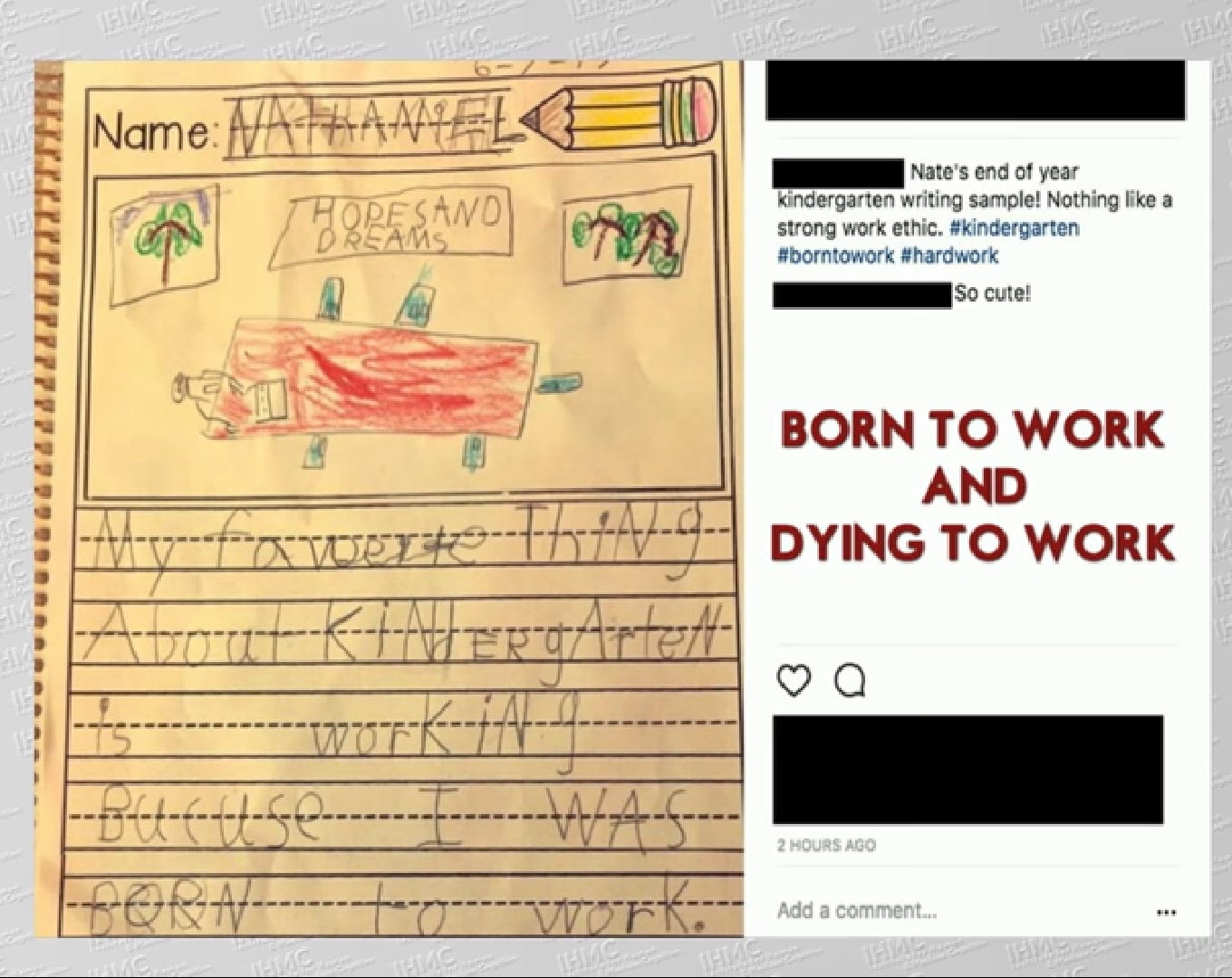
He proposes that “Total Work” is the hidden driver that keeps all of this alive. He summarizes Total Work as the assumption that we “are born to work, live to work and are dying to work”
He offered two powerful examples. The first was a real drawing from a Kindergartner who was convinced that his life purpose was to be on that laptop in the corner office:
“My favorite thing about kindergarten is working because I was born to work”
He also cites Marissa Mayer’s expert advice (because she did it) on working 130 hours:
The actual experience was more like, “Could you work 130 hours in a week?” The answer is yes, if you’re strategic about when you sleep, when you shower, and how often you go to the bathroom. The nap rooms at Google were there because it was safer to stay in the office than walk to your car at 3 a.m. For my first five years, I did at least one all-nighter a week, except when I was on vacation—and the vacations were few and far between.
From here he starts trying to dig into history and religion to see how we got here. He details the history of how “work” as we define it today, was held in contempt for most of history. He then details how in the 1500s during the Protestant Reformation, work became transformed from something that the bible talks about as a universal duty to something that could be mapped to the individual:
“if you do not work, then you shall not eat. As I understand it, until quite recently, till that time, this was taken more liberally to mean, if human kind does not work, then human beings shall not eat. But the more literal interpretation wins out such that it reads, if each person does not work, then each person shall not eat.”
He frames this as the beginning of a shift that eventually morphed into something more total which he calls the “work ideal” which has had a powerful stranglehold on our imagination ever since. It is made up of three parts:
- Work is good for you and makes you a better person
- Work is an inherent good and an end in itself. It is a reason for living: “to be is to work”
- Work is a supreme good held in esteem with love, goodness, beauty, truth, and peace
So this is all well and good, but what is his alternative? He does not suggest that we abandon work like many “post-work” thinkers. Instead he says we need to both redefine our conception of work to one that is founded on “care, responsibility, and attention on fineness” and to expand our imagination for a broader definitions of what it is to work beyond the current default of a full-time job.
The philosophical set of questions he leaves people with seems like a good way to start. If we are not really workers, then…
- Who are we?
- How did we get here?
- What responsibilities do we have?
- How can we put our lives together?
Do check out the talk:
If Work Dominated Your Every Moment, Would Life Be Worth Living?
From The Pathless Path:
During the first few months of self-employment, I read an article that jolted my reality. In a piece titled “If Work Dominated Your Every Moment, Would Life Be Worth Living?” the philosopher Andrew Taggart offered a powerful question that spoke to the underlying tension I lived with for most of my adult life.
Yet when I became self-employed, I was surprised at how strongly I had internalized a worker identity. As I struggled to find my first project, I felt guilty when I wasn’t working during typical work hours Monday through Friday. When I started working remotely on my first project, I had 100% control over when and how I did the work, but quickly fell into a routine of going to a coworking office five days a week. Many self‑employed people are surprised to find that once they no longer have to work for anyone else, they still have a manager in their head.
As I started to experiment with how I spent my time, Taggart’s question remained in my head. I was fascinated by his claim that we lived in a time of “total work,” a state of existence in which work is such a powerful force that almost everyone ends up identifying as a worker first and foremost. The idea of total work was inspired by the German philosopher Josef Pieper, who first wrote about it in his book Leisure, the Basis of Culture. Writing in Germany after World War II, Pieper was shocked at how people were eager to throw themselves into work without pausing to reflect on what kind of world they wanted to build. To Pieper, this was evidence that German society had abandoned a connection to a traditional form of leisure.
Pieper argued that for most of history, leisure was one of the most important parts of life for people in many cultures. He noted that the ancient Greek translation for work was literally “not-at-leisure.” In Aristotle’s own words, “we are not-at-leisure in order to be-at-leisure.” Now this is flipped. We work to earn time off and see leisure as a break from work. Pieper pointed out that people “mistake leisure for idleness, and work for creativity.” To Pieper, leisure was above work. It was “a condition of the soul,” and the “disposition of receptive understanding, of contemplative beholding, and immersion—in the real.”
As I embraced the freedom of self‑employment, I was opening up to this kind of leisure but was also still dealing with the lasting power of a world of total work that I had fully embraced, one where my perceived value was derived from my ability to keep working. Yet Taggart’s question remained a daily companion:
If work dominated your every moment, would life be worth living?
My answer was becoming a clear “No,” but I didn’t know what this meant for my life. Eventually, I reached out to Taggart directly and he proposed three more specific questions:
- Are you a worker?
- If you are not a worker, then who are you?
- Given who you are, what life is sufficient?
While these questions were terrifying, I was ready to start asking them seriously. According to Taggart, living in a world dominated by total work undermines the “playful contemplation concerned with our asking, pondering and answering the most basic questions of existence.” As I gained confidence on my new path, I was starting to be able to ask these questions and was open to the possibilities that were about to emerge.
In a World of Total Work
From How Obsession With Work Killed Our Connection With Leisure:
In a world of “total work,” there is no space for contemplation or rest. There is no need for people to be in “harmony with themselves” as long as they are employed. To “know thyself” is a secondary concern, and any sort of break from work is merely in the service of doing more work.
Decentering Work
From my 2023 newsletter, Time To Reintroduce Myself, I’m Paul:
In that first year after piecing together some consulting income and making $20k in a single month, I decided that I had “earned” a year of living expenses (which I had gotten down to $36k a year in Boston) and that I should just stop working for money to see what would happen. This was my own frustration with work and inspiration from two main sources. First, Charles Eisenstein’s Sacred Economics where I learned about the “spirit of the gift” and trying to align our lives around offering what we truly want to give. The second was Andrew Taggart’s writing, and his idea that we lived in a work-first reality, something he called “Total Work.” He wrote an article titled If work dominated your every moment, would life be worth living? Upon reflection, I saw that everything I had done up to that point in my life had been downstream of the assumption that the most important things in life were work and money.
The most interesting thing for me to do then was to test in my own life if I could decenter work as the most important thing. My working conclusion is that while you certainly can’t escape work you can definitely make some interesting tradeoffs worth pursuing if you don’t accept that adulthood is mostly a time when you should be continuously working for a company. The hard thing about this is that it requires constant tweaking and reflection. This is fine though as I like thinking through this puzzle and enjoy writing about it all. I’m six years into this stubborn mission and I’m gaining more and more confidence that I don’t need to surrender 100% of my time to the demands of work and money.
More on Total Work
- The Case Against Work: Ignoring enormous human suffering and potential
- Meaning Making & Dying To Work
- The Future Of Work Is Five Different Conversations
- Vacation is a poor substitute for leisure: Rethinking the role of rest in the modern world
- Nine “Schools” of Work: Where Our Modern Work Scripts Come From
- The (Real) Dark Side Of Management Consulting
- How Obsession With Work Killed Our Connection With Leisure
- Book Review: Chop Wood, Carry Water by Andrew Taggart, on Work as a Mundane Spiritual Practice