What I think
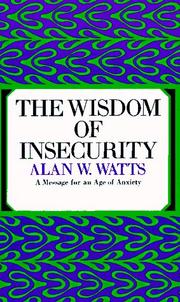
I highly recommend Alan Watts’ Wisdom of Insecurity. It’s a shorter read and holds up quite well in modern times even though it was written in 1951.
In 2018, it was one of my most highlighted books of the year. Wisdom of Insecurity and The Book are both very readable and short.
The best part of being self-employed is not knowing what’s going to happen. That would have sounded crazy to my past self. But the joy of finding out is really the other side of insecurity. As Alan Watts said, there is wisdom in insecurity.
We need more Alan Watts energy. Serious about ideas. Not serious about ourselves.
What the book is about
Watts argues that the more we try to make life secure, the more insecure we feel. We live for a future we can never quite reach, prepare for a life we never get around to enjoying, and reach for stimulation to escape the boredom of work. His alternative is to stop grasping, pay attention to the present, and let go of the idea that life can be held still.
Highlights
Security
the desire for security and the feeling of insecurity are the same thing. To hold your breath is to lose your breath. A society based on the quest for security is nothing but a breath-retention contest in which everyone is as taut as a drum and as purple as a beet.
We look for this security by fortifying and enclosing ourselves in innumerable ways. We want the protection of being “exclusive” and “special,” seeking to belong to the safest church, the best nation, the highest class, the right set, and the “nice” people.
The more one studies attempted solutions to problems in politics and economics, in art, philosophy, and religion, the more one has the impression of extremely gifted people wearing out their ingenuity at the impossible and futile task of trying to get the water of life into neat and permanent packages.
Living in the future
The power of memories and expectations is such that for most human beings, the past and the future are not as real, but rather more real than the present.
The power to remember and predict….is a wonderful development…but the way in which we generally use this power is apt to destroy all its advantages
This kind of living in the fantasy of expectation rather than the reality of the present is the special trouble of those business men who live entirely to make money. So many people of wealth understand much more about making and saving money than about using and enjoying it
Religion wants to assure the future beyond death, and science wants to assure it until death, and to postpone death.
Work and stimulation
Consequently our age is one of frustration, anxiety, agitation, and addiction to “dope.” Somehow we must grab what we can while we can, and drown out the realization that the whole thing is futile and meaningless.
To keep up this “standard” most of us are willing to put up with lives that consist largely in doing jobs that are a bore, earning the means to seek relief from the tedium by intervals of hectic and expensive pleasure. These intervals are supposed to be the real living, the real purpose served by the necessary evil of work.
The perfect “subject” for the aims of this economy is the person who continuously itches his ears with the radio, preferably using the portable kind which can go with him at all hours and in all places.
His eyes flit without rest from television screen, to newspaper, to magazine, keeping him in a sort of orgasm-with-out-release
Thus the working inhabitants of a modern city are people who live inside a machine to be batted around by its wheels. They spend their days in activities which largely boil down to counting and measuring, living in a world of rationalized abstraction which has little relation to or harmony with the great biological rhythms and processes.
Specialization in verbiage, classification, and mechanized thinking has put man out of touch with many of the marvelous powers of “instinct” which govern his body.
This kind of thinking goes so deep that we can’t even recognize it. We are raised to be analytical specialists.
The limits of self-improvement
There must be a good “I” who is going to improve the bad “me.” “I,” who has the best intentions, will go to work on wayward “me,” and the tussle between the two will very much stress the difference between them.
Belief and faith
Belief clings, but faith lets go
But you cannot understand life and its mysteries as long as you try to grasp it
Joy and the present
In moments of great joy we do not, as a rule, stop to think, “I am happy,” or, “This is joy.”
Sorrow can only be compared with the memory of joy, which is not at all the same thing as joy itself.
when we try to understand the present by comparing it with memories, we do not understand it as deeply as when we are aware of it without comparison
We suffer from the delusion that the entire universe is held in order by the categories of human thought, fearing that if we do not hold to them with the utmost tenacity, everything will vanish into chaos.
But there is no formula for generating the authentic warmth of love. It cannot be copied.